



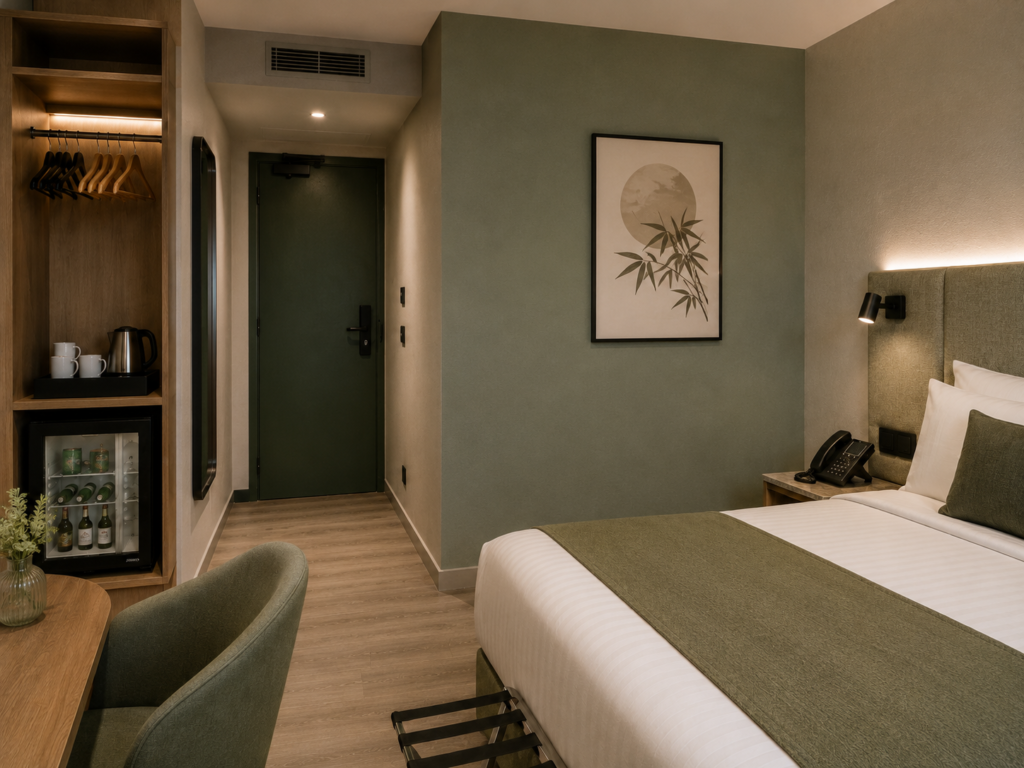
A minibar stays plugged in 24 hours a day, 365 days a year, in every room. So when a hotel chooses a minibar, the purchase price is only part of the decision: the electricity bill repeats every month for the whole life of the unit. In this article we explain how much electricity a hotel minibar uses, what it costs per year depending on the cooling technology, and which figures on the data sheet you should check so you don’t get it wrong.
How much electricity does a hotel minibar use?
It mainly depends on the cooling technology and the specific model. If we look at the data sheets of the 30-40 litre minibars currently on the market, the declared consumption falls within these approximate ranges:
- Absorption minibar: between 0.7 and 0.95 kWh per day, or about 265-350 kWh per year.
- Thermoelectric (Peltier) minibar: between 0.13 and 0.5 kWh per day depending on the model, about 50-185 kWh per year.
- Latest-generation compressor minibar: between 0.15 and 0.26 kWh per day, about 55-95 kWh per year.
As you can see, the gap between the minibar that uses the most and the one that uses the least can be five to one. In a single room it seems small; in a 50- or 100-room hotel, it isn’t.
Annual cost per room and per hotel
To convert kWh into euros we have used a reference price of €0.15/kWh. Your tariff may be different: multiply the annual consumption by the price you pay to get your exact figure.
| Technology | Approximate annual consumption | Cost per room per year | Cost for a 50-room hotel |
|---|---|---|---|
| Absorption | 265-350 kWh | €40-52 | €2,000-2,600 |
| Thermoelectric (Peltier) | 50-185 kWh | €8-28 | €400-1,400 |
| Latest-generation compressor | 55-95 kWh | €8-14 | €400-700 |
| Simex 30 L minibar (thermoelectric) | 60 kWh | €9 | €450 |
Over ten years, a reasonable service life for a minibar, the difference between an absorption model and an efficient one can exceed €15,000 in a 50-room hotel. It is money that doesn’t show up on the purchase invoice, but you pay it all the same.
Absorption, thermoelectric or compressor: what changes day to day
Consumption isn’t the only criterion. In a hotel room, noise matters as much as the bill: a minibar that hums at night ends up in a bad review. This is how each technology behaves:
Absorption minibar
It cools using a heat-driven circuit and has no moving parts, so it is completely silent. Its weak point is consumption: it is the technology that uses the most energy and the one that depends most on good ventilation in the cabinet where it is installed.
Thermoelectric (Peltier) minibar
It uses a semiconductor plate that moves heat from the inside to the outside. It has no compressor either, so it can run at 0 dB, and current models have low consumption. It is a well-balanced option for hotels that want silence without driving up the electricity bill. Bear in mind that it cools slightly less than a compressor (it usually works at around 8-15 ºC), which is enough for drinks and snacks.
Compressor minibar
It works like a domestic fridge: it cools the most and, in recent models, uses the least energy. In return, you can hear the compressor when it starts. Some manufacturers solve this with night modes or low-vibration compressors, but it is worth checking the noise level on the data sheet before choosing one for guest rooms.
| Absorption | Thermoelectric | Compressor | |
|---|---|---|---|
| Consumption | High | Low to medium depending on the model | Low |
| Noise | Silent (0 dB) | Silent (0 dB on many models) | Audible when it starts |
| Cooling capacity | Medium | Medium (drinks and snacks) | High |
| Moving parts | No | No | Yes |
To go deeper into the technical differences, read Absorption minibars and thermoelectric minibars: everything you need to know.
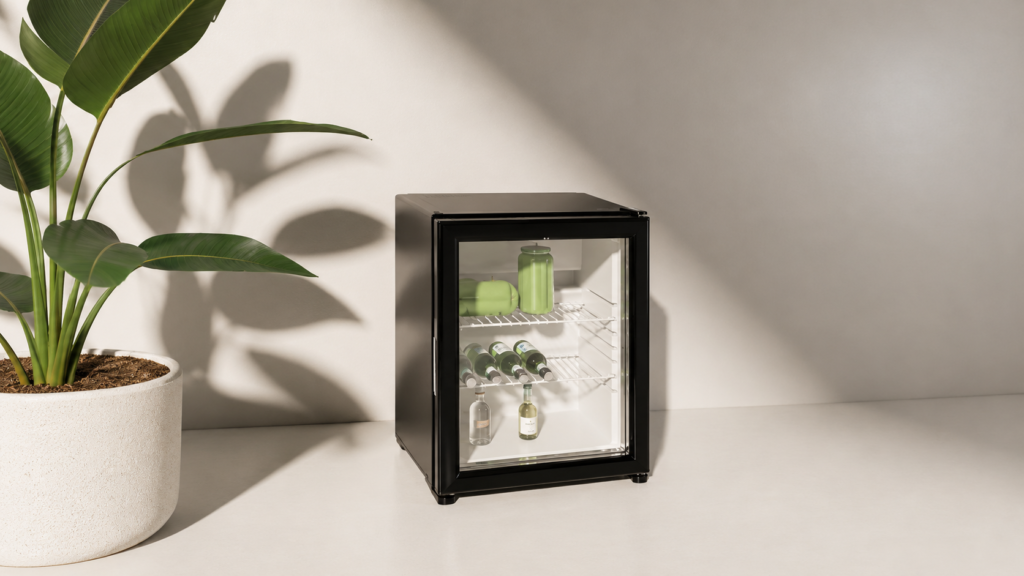
What to check on a minibar data sheet
More than the technology, it is the data sheet that tells you how much you will really pay. Look at these figures:
- Consumption in kWh/year or kWh/24 h. This is the key figure. If it is given per day, multiply it by 365.
- Power in watts (W). It shows the maximum the unit can draw, not what it actually consumes. Don’t confuse it with consumption.
- Noise level in dB. For guest rooms, 0 dB or very close is ideal.
- Temperature range. Check that it suits what you will offer: drinks, snacks, water.
- Capacity. For a standard room, 30 litres is usually enough; 40 litres if you offer more variety or long stays.
- Refrigerant. Natural gases such as R600a have a much lower environmental impact.
Five tips to reduce your minibar’s consumption
- Leave space for ventilation. A minibar boxed in with no outlet for warm air works harder and uses more. Follow the clearances given by the manufacturer.
- Set the temperature correctly. Every extra degree of cold shows up in consumption. Drinks don’t need the coldest setting.
- Keep it away from heat sources, such as radiators, windows in direct sunlight or the air-conditioning outlet.
- Check the door seal. A worn seal lets the cold escape.
- Consider switching it off in empty rooms during the low season, if your operations allow it.
To choose the right capacity or learn how to look after it, read everything you need to know about minibars.
Simex minibars
Simex minibars are thermoelectric with a Peltier system: they run at 0 dB, use R600a refrigerant and include LED lighting. The 30-litre model has a declared consumption of 60 kWh per year, which at €0.15/kWh means about €9 per room per year. They are available in 30 and 40 litres, with a solid or glass door, in black or white.
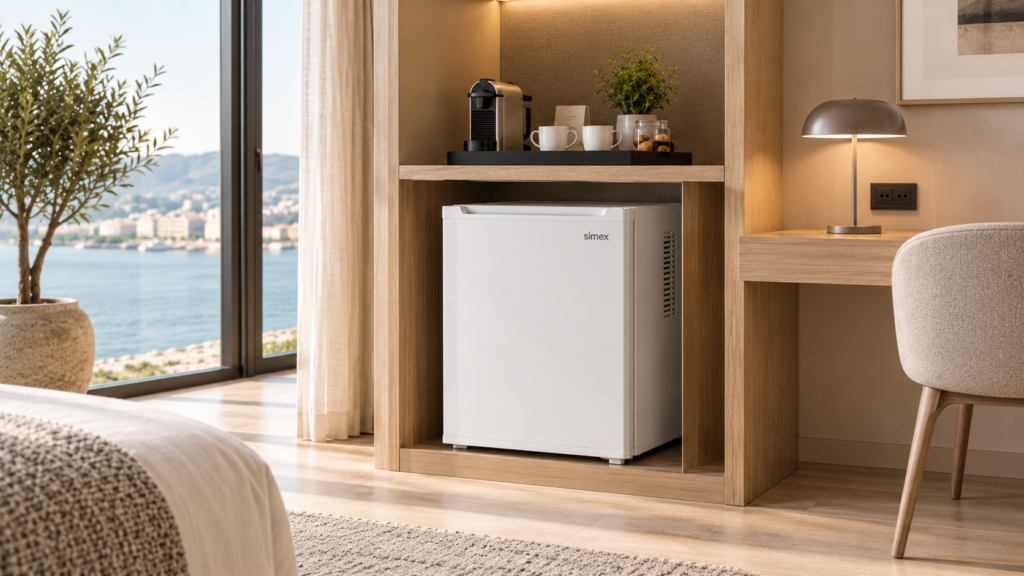
See all models on our website: Simex hotel minibars.
Frequently asked questions
How many kWh does a minibar use per day?
From about 0.15 kWh in the most efficient models to almost 1 kWh in absorption models. A 60 kWh/year thermoelectric minibar, like the Simex 30-litre model, uses about 0.16 kWh per day.
Which minibar is the quietest?
Absorption and thermoelectric minibars, because they have no compressor. Many models using either technology run at 0 dB.
Is a compressor or an absorption minibar better for a hotel?
A compressor minibar uses less energy and cools more, but makes some noise. An absorption minibar is silent, but uses considerably more energy. For guest rooms, a low-consumption thermoelectric minibar is often the middle ground: silent and with a controlled bill.
What minibar capacity do I need for a hotel room?
For a standard room, 30 litres is enough for drinks and a few snacks. For suites, apartments or long stays, 40 litres is better.
Are you fitting out or refurbishing your hotel rooms? Contact our sales team and we will help you choose the minibar that best suits your rooms.